
Tristan Name Meaning Bible: Holy & Spiritual Guide 2026
The Tristan name meaning Bible reveals profound insights that link this popular name to biblical themes and narratives. We will break down its etymology, significance, and spiritual relevance, providing you with a deeper understanding of how such names can influence our lives.
By the end of this article, you will appreciate the name Tristan not just as a label, but as a meaningful element of faith and identity.
What Does the Name Tristan Mean In the Bible?
The name Tristan, while often associated with the legend of Tristan and Isolde, doesn’t have a direct biblical reference or meaning within the scriptures. Understanding its roots can provide fascinating insights into its significance.
Many scholars suggest that Tristan could be derived from the Latin word “tristis,” meaning “sad” or “sorrowful,” which may evoke parallels to biblical themes of suffering and redemption found throughout the text.
Etymology and Historical Origins of Tristan
The name Tristan carries a rich etymological tapestry that intertwines both Latin and Celtic traditions. Rooted in the Latin word “tristis,” which translates to “sad” or “sorrowful,” it reflects the poignant narrative of its most famous bearer, Tristan of the Arthurian legends.

His tale embodies themes of heroism, loyalty, and steadfastness, resonating deeply with audiences across generations.
In the enchanting world of Celtic mythology, the name also signifies a strong warrior, weaving together the duality of joy and sorrow inherent in love and adventure.
Is the name Tristan in the Bible?
The name Tristan, while not explicitly mentioned in the Bible, carries significant cultural and literary resonance that can offer intriguing interpretations.
Often associated with the legend of Tristan and Isolde, the name embodies themes of love, sacrifice, and chivalry — ideas that parallel various biblical stories.
One could argue that the essence of Tristan, as a character driven by love and loyalty, mirrors figures like David, who displayed profound devotion in both friendship and love.
Tristan Name Meaning Bible
The name Tristan, while not directly mentioned in the Bible, carries a rich tapestry of meanings and interpretations influenced by various cultural and historical contexts. Its roots are often traced back to the Latin “tristis,” which means “sorrowful” or “sad,” reflecting a depth of emotion not often associated with names today.
This poignant essence invites deeper contemplation on the journey of life, suggesting that within sorrow, there emerges resilience and strength, embodying a narrative that resonates with many biblical themes.
Spiritual Significance of the Name Tristan
The name Tristan, often associated with the Celtic legend of Tristan and Isolde, carries a depth that resonates with themes of love, passion, and sacrifice.
Those who bear this name might find themselves radiating a sense of nobility and emotional intensity, qualities that can be traced back to the character’s storied past.

The Tristan name meaning in the Bible is not explicitly defined, yet it echoes the spiritual journey of many biblical figures who navigated love, loyalty, and conflict, adding a layer of spiritual significance for modern bearers.
Tristan in Biblical History and Tradition
The name Tristan, often associated with tales of chivalry and romance, possesses a deeper spiritual resonance that aligns with biblical principles and Christian tradition.
Rooted in Latin and Celtic origins, Tristan symbolizes not only passion but also faithfulness, courage, resilience, and moral integrity — qualities that echo through the lives of biblical figures like Joseph, Daniel, and David.
Each of these figures exemplified faithfulness in the face of adversity, showcasing a steadfast commitment to divine purpose despite overwhelming challenges.
- Faithful service to God _ In various interpretations, Tristan reflects the characteristics of devotion and sacrifice seen in Biblical figures like David and Jonathan.
- Strength through adversity _ Tristan’s story embodies the concept of finding strength through adversity. Much like Job or David, his experiences illustrate that struggles can forge a stronger character and impart wisdom.
- Moral and spiritual heroism _ The biblical tradition is filled with instances of moral and spiritual heroism, echoing the ideals encapsulated in the name Tristan.
Read Also: 50+ What the Enemy Meant for Evil Verses That Show God’s Goodness
The Origin of Tristan in Celtic and Christian Culture
The name Tristan, often linked to the themes of honor, love, and bravery, has deep roots in both Celtic legends and Christian cultural interpretation.
In Celtic mythology, Tristan emerges as a celebrated hero, notably featured in the tragic love story of Tristan and Isolde. This narrative weaves a rich tapestry of passion and conflict, illustrating how love can inspire noble deeds while simultaneously leading to profound sorrow.
The original meaning of Tristan — often interpreted as “sorrowful” or “tumult” — speaks to the trials faced by the protagonist, who must navigate the tumultuous waters of fate and desire.
Key aspects of Tristan in Celtic and Christian culture are as follows:
- Celtic Legends – The narrative explores themes of forbidden love and loyalty, with Tristan depicted as a courageous knight caught between love and duty.
- Medieval Romance – The medieval romance surrounding Tristan epitomizes the complex interplay of love and conflict.
- Christian Symbolism – Within Christian symbolism, Tristan’s journey represents the paradox of suffering and love as pathways to spiritual enlightenment.
- Spiritual Inspiration – The enduring legacy of Tristan transcends time, inspiring countless artists, poets, and believers.
Why Parents Choose Tristan: A Biblical Perspective
Parents often gravitate towards the name Tristan for its rich historical and biblical connotations. While not explicitly mentioned in the Bible, the name evokes a sense of strength and resilience, qualities deeply embedded in scriptural narratives.
The association of Tristan with “tumult” or “noise” symbolizes the challenges of life, much like the trials faced by biblical figures such as Job or David.
For parents, this provides a reminder that growth often comes through adversity, a fundamental theme woven throughout the scriptures.
Tristan Name Meaning in Hebrew and Greek
The name Tristan carries a rich tapestry of meanings across different cultures, particularly in Hebrew and Greek contexts, which are as follows:
Tristan Name Meaning Hebrew Context
In the Hebrew context, the name Tristan is often associated with meanings tied to sorrow or tumult, drawing parallels to biblical narratives that explore the complexity of human emotions.
Although not explicitly found in the Bible, the name evokes themes present throughout scripture — namely, the duality of strength amidst struggle.
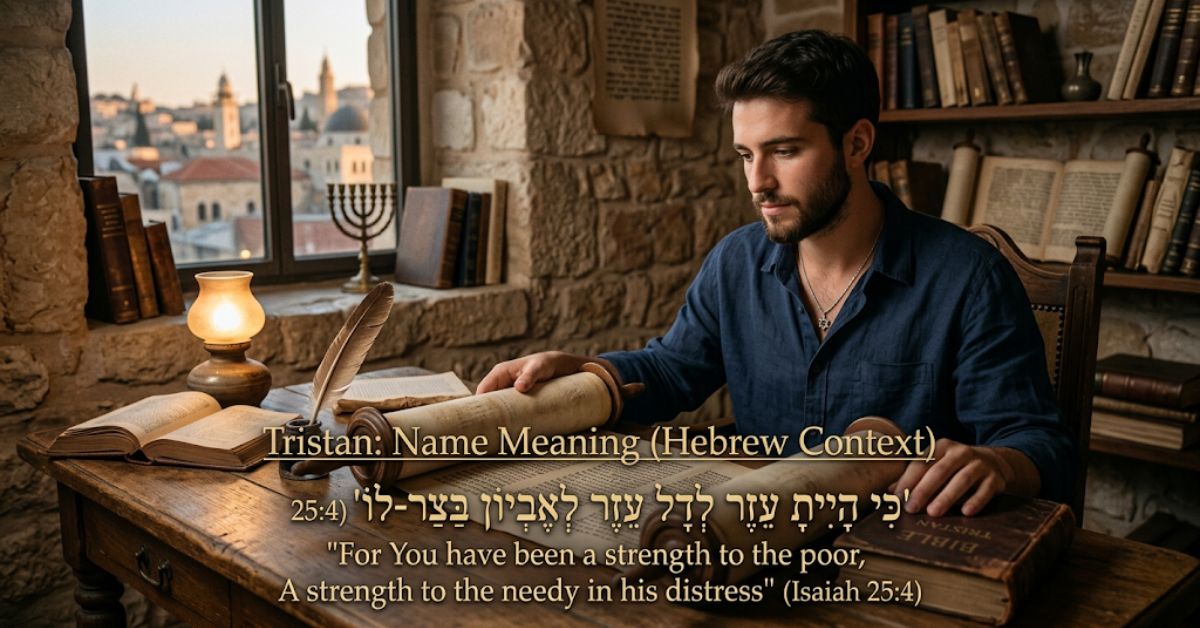
The biblical figures often embody resilience while navigating through trials, resonating with the etymology of Tristan, which can be interpreted as a reflection of life’s challenges and the strength required to face them.
Tristan Name Meaning Greek Context
In Greek contexts, the name Tristan carries a depth that transcends its more common associations. Rooted in the term “triste,” meaning “sad” or “sorrowful,” Tristan is often linked to the tragic love story of Tristan and Isolde.
In the realms of Greek literature and early Christian texts, the name also embodies themes of sacrifice and redemption. One can find echoes of this duality in biblical contexts, where sorrow often precedes profound transformation — a vivid reflection of the human experience.
The Cultural and Religious Impact of the Name Tristan
The name Tristan carries a rich tapestry of cultural and religious significance, often resonating with themes of love, tragedy, and heroism.
Derived from the Latin “Tristinus,” meaning “sorrowful” or “sad,” the name gained prominence through the medieval romance of Tristan and Isolde, illustrating how literature can shape cultural perceptions.
This narrative, deeply embedded in European folklore, reflects the complexities of love and loyalty, echoing biblical themes where love often intersects with sacrifice and moral dilemmas.
Cultural Influence
The name Tristan, often linked to its rich roots in the Arthurian legend, brings with it a tapestry of cultural significance that extends far beyond mere storytelling.
In biblical contexts, the name carries a weighty connotation, suggesting boldness and tumult, reflecting some of the trials faced in religious texts. This duality enables Tristan to resonate within various cultures, symbolizing both the valor and the complexities of human experiences.
Religious and Spiritual Influence
The name Tristan holds a profound significance within religious and spiritual contexts, often linked to themes of strength and resilience. Derived from the Latin “Tristanus,” its etymology is rich with narratives that echo throughout biblical traditions.
While the name itself may not appear in the Bible, its resonances are felt through stories of tragic heroes and unwavering faith, mirroring the challenges faced by figures like Job or David.
What the Bible Teaches About Names and Identity
In the Bible, names carry profound significance, often reflecting an individual’s identity and divine purpose.
For instance, the name “Tristan,” though not explicitly mentioned in biblical texts, resonates with the themes of sorrow and tumult. This correlation evokes a deeper understanding of how names can encapsulate experiences and emotions, shaping one’s destiny within the biblical narrative.

For example, Jacob, whose name means “supplanter,” underwent a transformative journey, ultimately becoming Israel, highlighting the potential for personal evolution and redirection in God’s plan.
Key Biblical Lessons About Names
- Names Reflect God’s Purpose: In the Bible, names are not mere labels but rather reflections of divine intent. For instance, the name “Tristan,” while not explicitly biblical, can invoke discussions around purpose, echoing how many biblical figures were named after their destinies.
- Names Indicate Character or Virtue: Throughout Scripture, names often reveal inherent qualities or virtues. For example, “Israel” means “he who struggles with God,” illustrating Jacob’s transformative encounter.
- Names Can Transform Identity: The act of renaming signifies profound change and new beginnings in the Bible. When God renamed Abram to Abraham, it marked a covenantal shift that transformed his identity and mission.
- Names Connect Generations and Heritage: Finally, names often serve as vessels of legacy and connection to ancestors. In the Bible, genealogies establish lineage, illustrating the importance of names in preserving family history and faith.
Application to Modern Names Like Tristan
The name Tristan, rich in history and meaning, captivates many with its deep-rooted origins. Traditionally linked to the tragic hero of Arthurian legend, it evokes themes of love and longing.
The name’s biblical associations offer a fresh perspective; while not explicitly mentioned in the Bible, it resonates with qualities of resilience and faith.
The “Tristan name meaning Bible” can be interpreted through the lens of fidelity and connection, reflecting the traits valued in biblical narratives.
Conclusion
Tristan Name Meaning Bible presents a fascinating exploration of a name that embodies strength, loyalty, and a connection to deeper spiritual truths. Its roots in significant biblical themes not only enrich our understanding of the name but also encourage us to reflect on its importance in our own lives.
As we navigate through the complexities of modern existence, the qualities associated with Tristan can serve as guiding principles. The name encapsulates a journey filled with both challenges and triumphs, making it a meaningful choice for many.
FAQs
What is the Biblical meaning of the name Tristan?
The name Tristan is not directly found in the Bible but is often associated with themes of sorrow or sadness, derived from the old French word “triste,” meaning “sad.”
Does Tristan have any Biblical Significance?
While Tristan itself isn’t a biblical name, it can symbolize struggles and resilience, reflecting the trials faced by biblical figures.
Are there any Biblical characters with a similar name to Tristan?
Not specifically, but figures like Job, who experienced immense suffering, may resonate with the underlying meanings attributed to the name Tristan.
What is the Origin of the name Tristan?
The name Tristan has mythical roots, particularly tied to the story of Tristan and Isolde, but it also has connections to French and Celtic languages, enhancing its historical significance.